50 Year Master Plan - Unified Theory of Thriving (UTT) and Global Institute of Thriving (GIFT)
 Image by Valiphotos
Introduction
One day in August 2020, I was doing a late night meditation session when, suddenly, my entire life’s purpose revealed itself to me in a deluge of clarity. Epic, for sure, and very intense.
The axiomatic premise was All Life seeks to Thrive. There is no agency in that - it is the driving force of all living things from single-celled organisms to the most complex life forms.
If Life seeks to Thrive, then any one expression of Life (i.e. you and me) is somewhere on the Thriving Path. The greater a life form’s sentience, the more it can rise from reacting to its environment to shaping its reality. Humans, then, can actively choose to be agents of Thriving (or not) for themselves individually and for all Life around them. That’s were personal choice comes into the equation.
I choose to be a pristine agent of Thriving
With the lights turned on, I could clearly see that I personally choose to empower Thriving, for myself and for others. When I recast my worldview and daily existence through that lens, I immediately saw many places that felt misaligned with whatever I imagine thriving to look and feel like. But all that was on an intuitive, subconscious level and it immediately begged 3 key questions:
- What circumscribes Thriving?
- How can we tell when a life form is Thriving?
- Assuming we can answer 1 & 2, how can I maximize Thriving for myself and for others?
Turns out, those are incredibly complex questions with only partial and directional answers today. What follows is the 50 year Master Plan, framed as a non-academic’s research proposal + an entrepreneur’s project proposal, that is my life’s quest to explore those questions on a theoretical and applied level. The theoretical output is the Unified Theory of Thriving (UTT) and the applied output - putting the UTT into action - is the Global Institute for Thriving (GIFT).
To be clear, both GIFT and UTT are no more mine or yours than lush old growth forests. They are humble expressions of what already is and forever will be - Life seeking every possible expression of Thriving.
A non-academic’s research proposal
Primary Researcher: Henry Finkelstein Supervisor: NA (for now) Institution: NA (for now) Start Date: December 12, 2020 Completion Date: December 12, 2070
Primary research question
What is the optimal path for individualized & collective human thriving?
- Human thriving = reaching peak potential (related to, but more inclusive than, self-actualization)
- Collective = interwoven groups of 2 or more people in any functional unit (i.e. family, geographic region, organization, interest group, colony)
- Individualized = custom-tailored to each unique individual - this will be based on a comprehensive Thrive Scan to map the qualitative and quantitative Thrive Markers for any given individual
- Optimal path = the shortest, gentlest, most accessible, most enjoyable evidence- and systems-based approach to facilitate Thriving - to maximize Thriving, the optimal path must be grounded in irrefutable evidence and reinforcing systems
Primary hypothesis
Thriving is an emergent property of peak physiological, psychological, and relational health.
Each of these is defined in more granular detail in the Master Plan project proposal below.
Assuming we can define the scope of each branch, imagine the Thrive Scan output as a 0-100 point scale from self-destructive unhealthy to perfect, vibrant, empowering health. (Note: it will not be this reductive, so forgive the oversimplification to explain the concept.)
The core hypothesis, then, is that full Thriving blooms when an individual is at 100 in each of the three branches. It is worth highlighting that each individual is unique, and so although the framework is intended to be universal, the individual expression of peak health will look very different from person to person.
To further elaborate, forward progress on the reductive scale is not uni-directional and, in any branch, an individual may regress based on external or internal stimuli (job loss, death in family, birth of a child, other major life event, etc) for short or extended periods of time.
One part of the applied Thriving Practice is observing and measuring where one is falling behind. The other part is implementing the interventions and systems to support in times of challenge and need.
This concept becomes especially fascinating (and somewhat more abstract) when we zoom out for any one individual to human collectives. Just as a body falters when one organ is failing, so too a group of individuals struggles to Thrive when one or more of the constituent parts (individuals) is not Thriving. But in a gestalt sort of way, I sense that collective Thriving is more than just the sum of its parts.
Secondary hypothesis
Life defaults to Thriving when unimpeded. Humans experience 3 core limiters:
- They do not know how to Thrive (awareness)
- If they know how, they do not have the resources to Thrive (context)
- If they know how and have the resources, they not have habituated the experience (practice)
The secondary hypothesis is that when each core limiter is systematically removed - when we “get out of our way” - humans cannot help but Thrive.
Background and Context
Origins of Positive Psychology
The scientific field of psychology is widely attributed to have formally begun in 1879 when Wilhelm Wundt established his experimental psychology lab in Leipzig, Germany. To be certain, philosophers and other academic disciplines had been exploring the nature of our brain and our thoughts for a long time before Wundt, but he was the first to apply the experimental scientific method in a formal way and distinguish psychology from philosophy and biology. From the late 1800s through the mid 1900s, psychologists around the world focused on either the nuts and bolts of cognition (i.e. memory, perception, internal processes, sensory stimuli) or on pathologies (“problems” that dropped people below “normal” baseline function). During that time, there was limited, if any, attention given to what elevates a “normal” person from baseline to extraordinary.
The tides of negativity began to turn in the second half of the 20th century with the rise of humanistic psychology. Humanistic psychologists offered a counterbalance to the other prominent theories of the time - Freud’s psychoanalysis and Skinner’s behaviorism - by suggesting that humans are inherently good and are driven by a higher purpose of self-actualization. The most famous of these psychologists, Abraham Maslow, popularized this concept with his “Hierarchy of Needs”.
Maslow’s work later inspired the field of Positive Psychology founded by Martin E.P. Seligman and Mihaly Csikszentmihalyi at the turn of the 21st century. Seligman first became famous with his work on learned helplessness in the 1960s and 70s. Frustrated by the field of psychology’s obsession with negativity and maladaptive behaviors, later in his career Seligman turned his attention to what is life-giving instead of life-depleting. He later teamed up with Csikszentmihalyi, famous for his work on the transcendent state of “flow”, to launch a whole new branch of psychology.
Positive psychology is a scientific approach to studying human thoughts, feelings, and behavior, with a focus on strengths instead of weaknesses, building the good in life instead of repairing the bad, and taking the lives of average people up to “great” instead of focusing solely on moving those who are struggling up to “normal”. (Peterson, 2008)
Positive psychology focuses on positive events and influences including:
- Positive experiences (like happiness, joy, inspiration, and love)
- Positive states and traits (like gratitude, resilience, and compassion)
- Positive institutions (applying positive principles within entire organizations and institutions)
To codify his findings, Seligman created the PERMA model to define wellbeing and flourishing:
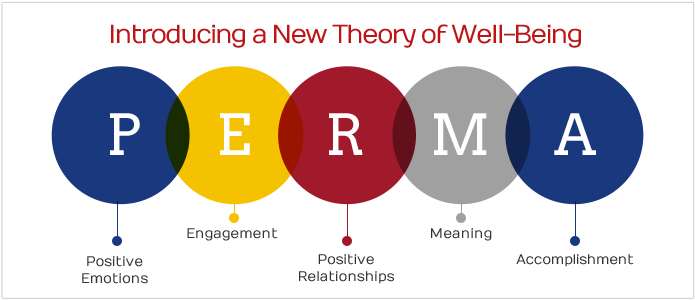
- Positive emotions
- Engagement
- Relationships
- Meaning
- Accomplishment / Achievement
Also core to the tenets of Positive Psychology is “flow” as coined by Mihaly Csikszentmihalyi. Flow state is characterized by 6 characteristics:
- Intense and focused concentration on the present moment
- The merging of action and awareness, or being fully present in your actions
- A loss of reflective self-consciousness (lack of attention to the self)
- A sense of personal control or agency in the situation
- A distorted sense of time passing
- Experiencing the activity or situation as intrinsically rewarding
In the last 20 years, there has been a rapid proliferation of this field with extensive research highlighting many theoretical and practical advances in the lives of individuals and organizations. Perhaps the most compelling finding of all is that “the good life can be taught”. How then, can we teach the good life? And how does that “teaching” change based on various populations and demographics?
Criticisms and limits of Positive Psychology
For all of the valuable contributions offered by the field of positive psychology, there are some notable limitations.
There is limited focus on the impact of physiological considerations (body systems, nutrition, neurochemistry, etc). For example, we now know that the gut biome can significantly impact “positive emotions”. Instead of changing any externalized reality, it may be more impactful to simply change one’s diet.
The studies have been historically culturally homogenous. How do these findings, and most importantly the practice of teaching the good life, adapt to distinct populations?
The field tends toward a reductive model of siloed observations instead of a systems-based approach. There have been studies underscoring that happiness and meaning do not go hand in hand, but there has not historically been an approach that looks at all the intersecting and overlapping nuances of various interventions, impacts, and outcomes (both intended and unintended).
The field is hyper-focused on the individual. What does positive psychology look like at larger units of the population? There is some work applying the concepts to businesses, but what about positive psychology within a relational pair or communities? A couple? A nuclear family unit? An extended family? How about geo-based communities such as a neighborhood, city, state, or country? Activity-based communities such as workplaces, artist groups, sports teams, clubs, and otherwise? Interest-based communities such as book clubs, study groups, distributed learning, and similar?
In his book Flourish, Seligman wistfully suggests we change the Gross Domestic Product (GDP) nation-wide measure to Gross Domestic Flourishing (GDF), but from what I’ve read so far, that’s about where the larger community conversation ends.
Furthermore, even if we did implement GDF, it’s not as simple as adding up the individual flourishing metric for each individual. How does this field approach situations where the desires or needs of the individual come into conflict with the desires or needs of the group? Where does the concept of personal sacrifice or teamwork come into the PERMA equation?
The field exclusively focuses on humans without any clarity on humans in the context of the natural environment. There is a lot of research underscoring the positive impact for individuals to be in nature. The lack of this context is a glaring example of the field’s homeo-centrism.
The field barely, if at all, touches a new narrative developing around consciousness. How does positive psychology relate to ineffable experiences? Mystical experiences can facilitate meaning, certainly, but that seems like a reductive bridge to build between the two disciplines. How can acute externalized events that drive greater awareness impact the “good life”? One example is the recent psilocybin research for clinically depressed, end-of-life cancer patients. The stark results from that study do not fit cleanly within the PERMA model for facilitating wellbeing.
Zooming out from psychology
Looking beyond psychological well-being, there is a similar trajectory in physical and relational health.
In nutrition, Kenneth Carpenter’s epic 4-part history of nutrition science highlighted all the incredible discoveries made about what is in our food and how it impacts our bodies. But that research was largely driven by the diseases and malnutrition du jour from scurvy to thiamine deficiency to goiter to rickets. Moreover, most all of the research done in those 200 years focused on isolating individual pieces - proteins, fats, vitamins, minerals, etc. - without fully understanding the interactions between the individuated pieces.
It’s only recently that nutrition experts like Shawn Stevenson began focusing on a systems-based approach to “model health” - going from baseline to extraordinary. This is a new and burgeoning field in nutrition science and our knowledge of optimal health and peak physical performance is rapidly evolving.
Similarly, it’s only within the last 25 years that we’re getting a grasp of why we sleep. Matthew Walker, author of Why We Sleep, and his team at the Center for Human Sleep Science have uncovered how sleep impacts a mind-bogglingly diverse set of physiological and cognitive functions. These pioneering researchers have conclusively proven that it is only possible to achieve peak physical and mental health with enough restful sleep.
And we can tell a similar story, albeit with fewer characters and a less developed narrative, about rigorous scientific inquiry into human relationships with the non-human world (i.e. nature) and the ineffable plane (sometimes referred to as spirituality). We now understand that contact with the natural world can positively impact us through a variety of mechanisms, and I’ll venture to say we’re just barely scratching the surface on that front. And there is currently a renaissance of compelling academic research into consciousness and mystical experiences.
From my humble vantage point, I sense that humanity is at an exciting tipping point of unearthing a broad, holistic, thoroughly researched systems-based understanding of how we can truly Thrive, individually and collectively. I seek to write down the notes of our collective chorus in the Unified Theory of Thriving.
Gaps this project will fill
The purpose of this project is to build on a diverse array of academic disciplines by broadening the iris of “wellbeing” and “flourishing” to the broader and more inclusive “thriving” that folds in:
- More scientific traditions (biology, chemistry, neurology, ecology, and many more)
- More non-scientific traditions (philosophy, ethics, arts, theology)
- More evidence-based prescriptive practices (interventions, programs, clinics, workshops, online courses)
- More systems-based thinking and theory
- Delineating software, hardware, and online solutions from no tech, offline solutions
- More diverse populations of individuals
- Greater focus on thriving limiters and how to overcome them
- Greater focus on collectives and communities
- Greater focus on diagnostics and feedback loops in daily life
- Greater focus on humans in the context of the non-human world (including, by extension, abstracting humanity from the context of Earth proper as we become an interplanetary species)
- Greater focus on non-human life
- Greater focus on the nature of consciousness and the ineffable plane
Thriving limiters are systems, structures, choices, or other dynamics that hold back Thriving. Instead of “adding something” to facilitate Thriving (i.e. adding a gratitude journal), it is often easier to “remove something” (i.e. processed sugar from one’s diet) to achieve a disproportionately large impact.
Key research question
Ultimately, this project will answer the question “I (and we) want to thrive - how do I (and we) start or accelerate my (and our) Thrive Practice?” in a data-driven, directive, interwoven approach that can be offered as education and training.
It is my life’s work to diligently explore, and to the best of my ability answer, that question. The Master Plan noted below enunciates exactly how I plan to do that.
The 50-Year Master Plan
The Master Plan to research and address this question is broken out in 4 distinct phases:
- Years 1-5 = Learn
- Years 6-10 = Practice
- Years 11-25 = Refine
- Years 26-50 = Expand
Phase 1 - Learn addresses the first core limiter of awareness. 5 years is nowhere near enough time to achieve mastery, but it’s enough time to do a thorough literature review on what various academic traditions understand and believe today. Once we have a rudimentary understanding, it’s time to start practicing.
Phase 2 - Practice applies the lessons learned in Phase 1 and begins putting them into action. This addresses, in a simplified way, the second and third core limiters, context and practice, respectively.
Phase 3 - Refine takes the learnings from diligently testing and validating our hypotheses and begins to institutionalize best practices.
Phase 4 - Expand is the audacious phase where we rapidly broaden our horizons to include Thriving for other countries and continents, other life forms, and other planets.
Phase 1 - Learn (Years 1-5)
Year 1: Physiological Health
The key objective of the first year is to understand a comprehensive picture of what “healthy normal” means as exemplified in a single fictional human male and a separate single fictional human female.
Note: There is nothing “healthy” nor “normal” about an average American. I have a sneaking suspicion that the “healthy normal” medical standard is far from optimal human health and body function.
This includes the sub-topics of:
- Nutrition (what we eat and drink)
- Movement (ease, strength, endurance, flexibility)
- Sleep
- Medicines (what we consume to go from sub-baseline to baseline function)
- Enhancements (what we consume to go from baseline to optimal function)
Each thread of each sub-topic will be woven into the larger tapestry of the 13 core body systems:
- Respiratory system
- Digestive system
- Cardiovascular system
- Urinary system
- Integumentary system
- Skeletal system
- Endocrine system
- Lymphatic system
- Immune system
- Nervous system
- Sensory systems
- Muscular system
- Reproductive system
At the end of the first year, I will have a rudimentary perspective on the markers of an average, healthy, human adult male and female body and basic methods to sustain “generally good” physical health.
Year 2: Psychological Health
The key objective of the second year is to understand a comprehensive picture of what a well-adapted, high-functioning, self-regulating “healthy normal” mental landscape looks like.
This includes the sub-topics of:
- Positive emotion (feeling joy, hope, excitement, satisfaction, etc.)
- Stability (reliability and consistency)
- Engagement (feeling captivated or content with the present moment)
- Meaning (feeling purposeful or a part of something bigger than the self)
- Accomplishment (feeling a sense of achievement, creation, or contribution)
- Zone of proximal development (growth edge)
Each sub-topic will be mapped to a broad cross-section of academic traditions: cognitive science, neuroscience, psychology, and behavioral economics. Each will be cross-mapped to specific areas of cognition: attention, language, knowledge, learning, perception, behavior, and consciousness.
Year 3: Relational Health
The key objective of the third year is to understand a comprehensive picture of what a well-connected, well-adjusted “healthy normal” relationship looks like in the domains of:
- Connection to self - mindfulness, meditation
- Connection to other humans - family, friends, communities (geography-based, activity-based, interest-based, faith-based), career/work, implicit and explicit networks
- Connection to non-humans - animates (animals, plants, fungi) and inanimates (earth, water, wind, fire, sky, space)
- Connection to the sacred - something greater (Life / Spirit / Source / God), ritual, sensuality, arts
Years 4 & 5: Synthesis and First Draft
The key objective of the final two years is to write, refine, and publish the first draft of the Unified Theory of Thriving. This first draft will include a comprehensive literature review on every aspect of Thriving I can find in academic literature in any discipline, including known gaps, contradictions, biases, or other limitations.
I will take these markers and distill them down to an assessment that I can take to qualitatively quantify my Thrive Score in each of the three branches and, ultimately, overall.
Phase 2 - Practice (Years 6-10)
Once I have an initial perspective of what thriving looks like for physical, mental, and relational health, I will put these concepts into practice.
I will first start with adults in narrow population sets, and as we gain traction and success we will expand the focus to more diverse adults.
As I am spinning up the applied practice for adults, I will also broaden the theoretical focus to “work my way backwards” from pre-birth to adult to expand the UTT to include Thriving through conception, pregnancy, birth, infancy, adolescence, and young adulthood. Each transition and inflection point along that life journey will contain specific and more nuanced considerations for every branch.
After developing a program for thriving pre-adults, I will focus my lens on Thriving in the latter years to round out the entire life cycle - aging, elders, and death.
I will develop data-driven online courses, workshops, on-site trainings, and coaching programs. A key component of this phase is diligently tracking each engagement and intervention to generate a short-cycle feedback loop.
During these years I will zoom out from the limiting framing of an average “healthy normal” and instead focus on hyper-personalized treatments. After diagnostics, the Thrive Path will generate rank-order prioritized “playbooks” with specific education, support systems, interventions (guide-managed activities) and home practice (self-managed activities).
I seek to launch a publishing house with the flagship academic journal “Thrive” - asking the question: What would it look and feel like for an academic journal about Thriving to practice what it studies?
The Global Institute for Thriving (GIFT) will be a profitable venture structured as a B Corporation with an unwavering commitment to a triple bottom line (people, place, and profit). I will purchase 100+ acres of land to develop a physical epicenter for this movement. Ultimately, I will launch the Thrive Incubator and Thrive VC to allocate funds into the hands of those who share a vision of a harmonious, balanced, and Thriving world.
Phase 3 - Refine (Years 11-25)
Once the growing team has a humble and basic understanding of the practice of facilitating Thriving, we will broaden the scope further to include more diverse and more challenged populations.
High-ticket value offerings will fund scholarship and grant programs to offer similar services to under-privileged populations. We will expand our work to include different cultural backgrounds within the United States, as well as individuals with genetic, systemic, or other structural limitations.
In this phase, our team will build the lasting physical structures and institutions that will stand for 300 years. I seek to develop a large campus complete with many different functional spaces - the general vision is a purpose-built Tier 1 small college town.
Other people will take over all the day-to-day operations and I will fade into the background to continue my devotional research, writing, and championing of the Thriving movement. The land itself will also be Thriving - we will implement regenerative best practices as we develop food forests to support the entire village population.
Phase 4 - Expand (Years 26-50)
Once we have established a resoundingly successful model in the US, the next phase transitions to dramatic expansion in many directions.
New geographies and cultures. We will build 5 new satellite branches on 5 different continents. We will translate the literature into dozens of other languages and adapt interventions to other cultural contexts.
New branches of the Life taxonomy. What does the science say about facilitating Thriving for animals? For forests and other plant life? For fungal life?
New planets. It is not sufficient to simply put humans on Mars or any other planet. Beyond the basic life functions (food, water, shelter, air), if we are to be a true interplanetary species, we will need to know not just how to survive on other planets, but also how to Thrive on other planets.
By year 50, I will distill everything I have done and learned into my magnum opus - the Unified Theory of Thriving (UTT).
I acknowledge my flavor of crazy
I am very aware that this project plan is hyper-aggressive and there will invariably be setbacks and complications that pull out the timeline.
The awareness of my ambitious (and likely unrealistic) timeline in no way limits my resolve to roll up my sleeves and get to work. If anything, it means I just need to get to work harder and faster now because I never know when I’ll hit those speed bumps along the way.
To be clear, I have no attachment to the dates and deadlines proper so much as an express commitment to walking this path and watching it unfold in whatever greater mystery and unknown is right around the bend. The direction of my path is guided by the North Star I can currently see, and I hold that lightly. If ever it needs to change, I will reorient to my new North Star and continue running in that direction as hard and fast as I can. After all, we’ve all got a lot of Thriving to do!
I warmly welcome your feedback, reflection, and support
If you think I’m another nut job that lost his grip on reality, you may be right! Also, I have no need or pull for external approval and will not stop my quest for any detractors or naysayers. Disregarding this project or me will not hurt my feelings or make me think any less of anyone. This is my life’s work, and I will humbly walk this path alone or with anyone who chooses to walk by my side.
That said, I know the path can be smoother and more efficient if I collaborate with the brilliant minds and caring souls that resonate with this vision. I welcome your feedback and input in whatever format feels inspiring to you.