GTM in Flux - AI Changed Everything, and Nothing
On July 6, a recruiter at an enterprise software company emailed me about a role.
I came across your profile and was impressed by your journey… Your knack for transforming data into actionable insights is truly impressive.
Seven days later, the same recruiter emailed me about the same role.
I came across your profile and was really impressed by your work… Your experience in GTM and Revenue Operations really stands out.
Same compliment, freshly rendered. As though the first email had never been sent.
The role both messages said “aligns well” with my background was Principal Application Product Manager in Customer Success. It isn’t remotely my background.
The recruiter most likely used AI to pull a few facts from my profile and arrange them into a generic compliment intended to catch my attention. It did, but for the wrong reason - no one seemed to have checked whether my background matched the job.
These two emails are a clean example of the tension inside GTM right now.GTM means go-to-market. It covers the revenue-facing functions that bring in and keep customers, including marketing, sales, customer success, and customer support. GTM also includes analytical and operational functions like revenue operations (RevOps), tooling acquisition and administration, and aspects of finance + legal that touch commercial terms and contracts. If it touches making money, it falls under GTM. Every function involved in selling and supporting B2B software - and in hiring the people who do it - can be rebuilt, and many already are changing. The reasons people trust a vendor or recruiter remain stubbornly human.
Both are true. The space between them is where the whole industry is currently thrashing.
Everything in GTM looks and feels different
Marketing can research every account before anyone writes a campaign. Sales can walk into each call with the full account history already synthesized. Customer success can find risk across thousands of conversations instead of whichever ten somebody had time to review. RevOps can reconcile what the CRM says with what actually happened on the call.
Legal, finance, support, onboarding - every function can execute faster and better than it did eighteen months ago.
I want to be unambiguous about this part: it’s wonderful.
Someone entering go-to-market today starts with research, synthesis, drafting, and production capacity that took me years to assemble. The production floor for entry-level work now clears what competent mid-level production looked like before the current generation of models and agentic tools.
People now have the ability to express what they know clearly, test an idea quickly, and arrive at better work sooner. That doesn’t mean they have good taste or discernment to use this superpower well.
The experienced practitioner’s old production advantage got cheaper. Their hard-earned judgment did not.
I don’t miss expensive busywork. I don’t want someone spending three hours formatting a deck just so I can infer that they care. A higher floor means more people can contribute at a higher level, earlier in their careers and without waiting for a large team to support them.
AI made competent execution abundant.
Which is exactly what killed the signal.
Polish stopped proving care
A polished artifact used to carry two things at once: the artifact itself and evidence that someone spent time making it.
A researched email suggested a person had done the research. A deck adapted to my company suggested someone had thought about my company. A specific follow-up suggested someone had listened. The finish was never perfect evidence of care, but it was evidence that scarce human attention had been spent.Economists call these costly signals: signals whose expense makes them informative. The time behind the artifact was part of what the artifact communicated.
AI unbundled the two.
The artifact can still be relevant, correct, and useful. Its finish no longer tells me how much effort, judgment, or care sits behind it. The email might contain excellent research. I now have to read it to find out.
The cost did not disappear. It changed sides.
Routine production became nearly free for the sender. Evaluation still costs human attention, so now the recipient pays. Every plausible email, thoughtful-looking comment, and competent deck creates a tiny inspection job for the person receiving it.
Measured in attention, I spent more receiving those emails than anyone spent sending them.
One inspection is trivial. Thousands are disabling.
The productivity gain accrues to the organization producing the work. The attention bill gets distributed across everyone it reaches.
This is why the noise feels different now. It isn’t merely more annoying. The familiar proxies buyers used to decide where to spend attention stopped working. Polish can no longer perform the first round of triage because it is available to everyone.
Routine, accessible research, first drafts, synthesis, and formatting got cheap. Excellence still requires taste, judgment, accountability, and access to context that doesn’t live in any database.
Care still matters. The familiar signals that once conveyed care have been diluted into noise.
The work has to change with the tools
I experienced one version of this new way of working during a recent pricing conversation.
A prospect raised concerns about the structure and cost of our proposed contract. We booked the follow-up for two hours later.
In the gap, one of my agents found a comparable account and showed how we’d adapted our standard rate card for that market. While it worked in the background, I spent an hour talking with a backend engineer and a forward-deployed engineer about what we could actually deliver. That information lived in their experience, not in a system an agent could query.
The call recording, account history, comparable pricing, and what I learned from those conversations then fed into my proposal generator. By the follow-up, I had an accurate, deliverability-checked proposal ready to send. The final proposal was 2.5x the original quote and addressed the prospect’s concerns about pricing and product fit. They were willing to spend more because they trusted that we understood their needs and could deliver.
The agents handled everything that could be retrieved or generated. I spent most of those two hours gathering knowledge that existed only in my colleagues’ heads and deciding what we should actually promise.
This is what I mean by agent-native GTM.
An AI-assisted team does more of the same work faster. Without changing how the work is designed, that added capacity becomes more volume, and more noise.
An agent-native team redraws the division of labor. My agents retrieve information, monitor what changes, reconcile systems, prepare materials, and route what matters. Humans keep judgment, commitments, exceptions, accountability, and the conversations where trust is at stake.
Then the reclaimed capacity creates more opportunities to build trust, with greater care in each one.
I built the same division of labor into an Auto-CRM that reads call transcripts, Slack, email, contracts, billing, and the actual work happening around an account to maintain deals, pipeline, and forecasts. I deployed the underlying GTM system to my team so my operating model could work at team scale.
My estimate for a typical week is that roughly 15% of my time maintains existing systems and another 25% builds new ones. The operating cost is real. In the remaining 60%, I estimate that I deliver 20-30x my pre-AI output, with much more of my time spent on discernment and quality.
Noise makes excellence harder to recognize
The floor rose. The ceiling rose further. From the recipient’s side, the gap between them became almost impossible to see.
The response has created a vicious cycle:
More noise makes attention harder to earn. Organizations respond by increasing volume. The added volume becomes more noise. Noise begets noise.
Old playbooks can still look rational from inside one team’s funnel, even as they degrade the channel for everyone.
Ethan MollickMollick is a professor at Wharton who studies AI’s effects on work and education, and one of my favorite thinkers writing about AI’s impact on business. His excellent book Co-Intelligence: Living and Working with AI (opens in a new tab) is already essential reading. His next book, Co-Existence: The Next Phase of AI (opens in a new tab), comes out October 20, 2026, and I can’t wait to read it. calls the resulting output “meaning-shaped attention vampires” (opens in a new tab). The phrase is funny because it is painfully precise: language masquerading as an idea consumes the same scarce attention as a real one.
The comments beneath one of Mollick’s recent LinkedIn posts offer a clear example. Three people posted variations of the same sentence:
“The biggest change isn’t that the models got smarter…”
“The biggest change is not that models became smarter…”
“The biggest shift isn’t from choosing the ‘best AI model’…”
Three commenters. One skeleton.
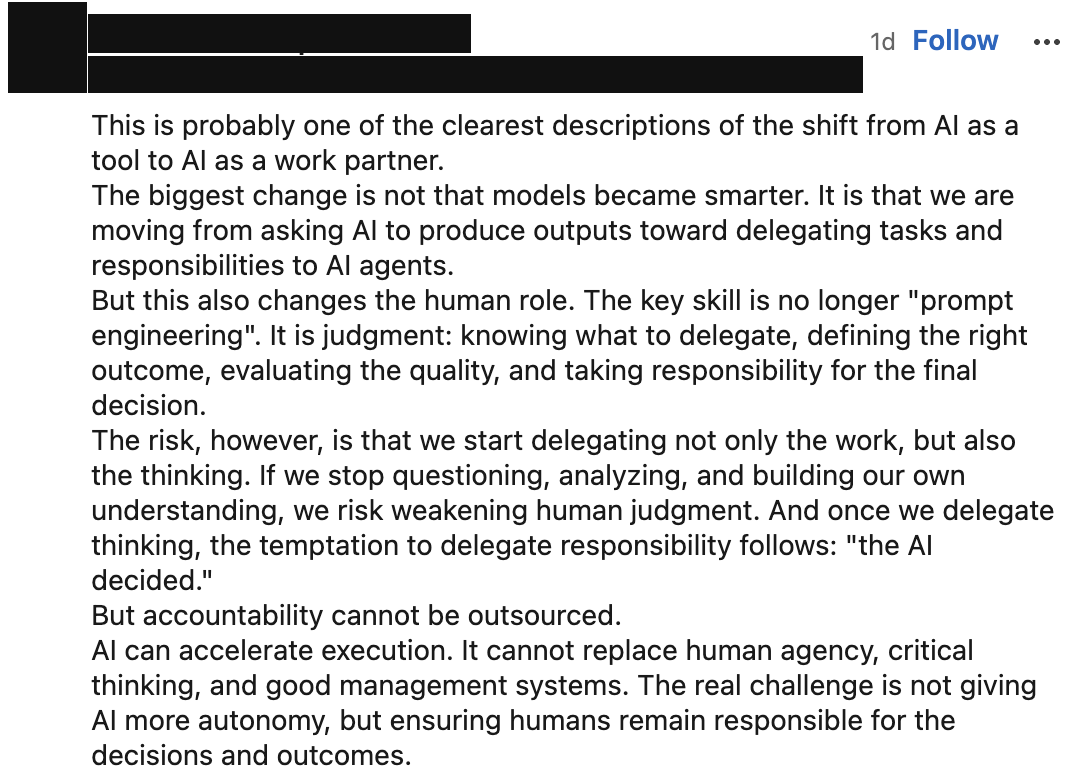
One of the three comments. Identifying information removed.
The repetition leaves me with the only fact that matters as a recipient: I cannot tell, and figuring it out is a waste of time.
Maybe each person independently arrived at the same observation and used AI to express it. Maybe the comments came from an engagement tool. From my side of the screen, they are indistinguishable.
The finished work no longer reveals how much thought went into it.
The better these systems become, the more easily ordinary output can adopt the finish of exceptional work. Discerning between them costs the reader the same attention the vicious cycle already taxed.
The cruel part is that even as the ceiling rises, excellence gets harder to recognize.
Excellence needs signals people can trust
Trust was already scarce before AI, and boundless slop is eroding it further. When excellence is hard to recognize, what earns trust today?
Judgment applied to a particular situation still carries information. So does a commitment that exposes the seller to consequences. A candid boundary - “we’re not good at that yet” - becomes meaningful when naming it might cost the deal.
Product value remains experiential. Useful follow-through only becomes visible over time. Advocacy matters when the person offering it has already borne the risk of being wrong.
These signals carry weight because direct experience tests the claim.
Recently, a vendor sent me a cold email that correctly named a problem in my world: voice-agent builders rarely publicize their agents before launch, which makes finding the right companies unusually difficult. The sender offered specific ideas for solving it.
I replied.
The email earned a call. The call earned a proof of concept. The proof of concept worked, and Coval became a customer.
The email didn’t close the deal. It earned the next few minutes of attention. The product and the people behind it justified what followed.
Credibility earned attention. Substance earned trust.
The contrast between the recruiter’s outreach and the vendor’s email is simple: one asked for my attention; the other paid attention first.
For all I know, the successful email was machine-drafted. So what? AI can produce better research, faster follow-through, and stronger proof. I use it to do all three, and it would be silly not to. The tension the email named was real. Its suggestions were specific to us, and the product proved it right.
AI made outreach cheaper to produce and more expensive to evaluate. A specific message may still earn a reply, while proof and follow-through determine whether trust grows from there.
Five questions I ask of my work today
I expect every motion to use AI today. In practice, that means I hold each one to a higher bar.
I ask five questions of everything I build and deploy:
- What would an exceptional practitioner create with unlimited access to researchers, analysts, writers, editors, and every other specialist their work requires?
- What value does this create for the recipient before asking anything from them?
- What evidence will earn attention and build trust in our expertise?
- Where do judgment, accountability, and conversation remain human?
- What will be done with the hours the system returns?
The fifth question closes the loop. It directs the hours the system returns into the work behind the first four - creating more value, exercising better judgment, and earning trust.
Four questions I can’t answer yet
The first principles are clear to me. How organizations adapt to this new capacity isn’t.
Does the rising cost of earning attention erase the capacity gain?
If one AE can now do work once split among three AEs and ten BDRsA business development representative, or BDR, is generally the entry-level seat that finds prospects and books meetings. An account executive, or AE, runs the sales process and closes the deal., how should quota change? How much of that capacity will be consumed by the rising cost of earning attention? What is a fair expectation for the salesperson?
Who captures the efficiency gains?
If five people can do work that recently required a hundred, where does the gain go - company margin, higher compensation for those five power players, lower customer prices, or simply more volume? And how should companies calculate that gain when token costs are tracked task by task, while the value people create extends beyond the tasks they complete?
Where will people acquire judgment?
The BDR role has long been the front door to a sales career, where people built judgment by making mistakes while the stakes were low. What do agent-native entry-level jobs look like? How should training and onboarding build judgment when agents perform much of the repetitive work that once taught the job?
Who gets credit for an agent’s work?
When an agent sources, opens, and advances a deal, who gets credit and who earns the commission? The person who originally designed the skillz?Skillz refers to the markdown files and workflows I build for agents. When I’m talking about human capabilities, I write it as skills so it’s easier to distinguish between the two. Oh, and if it’s helpful, my inner voice reads skillz as “skeeeeeellllzzzz.” The person who fixed the agent pipes when the cron jobs failed? The salesperson who was technically in the loop but approved every proposed message without changing a word? What changes if that salesperson edits one word? How much human intervention is enough to earn the win?
Capacity should deepen trust
I don’t trust confident answers to these questions yet, including my own. I’m operating as if they need real answers in the next twelve to twenty-four months. I expect agent-native organizations to move into the mid-market and enterprise with smaller human teams and much larger agent teams.
My design conviction is simple. Agents should create capacity for the very human work that hasn’t changed: earning trust.
The signals are no mystery. Demonstrated judgment, real commitments, delivered value, and useful follow-through still work.
The open problem is making those signals visible at scale when weak and strong work look so similar.